The Contrast Between City and Mountain Life
The Eight Mountains: A NovelThe Contrast Between City and Mountain Life organizes the narrator’s understanding of family, memory, and adulthood. Milan is the place of traffic, work, and estrangement, while the mountains are places of exertion and return; yet neither side remains fixed. The city carries the parents’ mountain past in songs and glances, and the narrator eventually discovers that the mountains preserve a version of his father he had barely known. The contrast becomes less a choice between two worlds than a way of measuring what each world can hold and what it leaves behind.
Milan: Noise, Work, and Distance
In the 1970s, the family lived on the seventh floor of a Milan apartment building above a broad avenue. Beneath its asphalt, the Olona was said to run, and rain could flood the road; above ground, traffic itself seemed like a river in spate. Cars, lorries, buses, scooters, and ambulances filled the avenue, their sound amplified by the identical buildings on either side. When the noise became unbearable, the narrator’s father would fling open the window, look down, then put on his coat and leave for a walk. The city is presented not as an abstract opposite to nature but as an environment that presses on the body and drives him outdoors.
The family’s view from the apartment also sets urban confinement against remembered rural life. The sky was visible through the windows, but appeared uniformly white, while the balcony was blackened by exhaust and stained by rain. The narrator’s mother nevertheless grew flowers there. As she tended them, she told him about the countryside in which she had grown up: vineyards in August, tobacco leaves drying on racks, and asparagus that had to be recognized and cut before breaking through the soil. Her memories supplied the small balcony with a different landscape, one passed down through speech even when the family was far from it.
Her work in Milan sharpened the contrast between pastoral memory and urban conditions. Formerly a nurse in the Veneto, she became a health worker in the western outskirts, supporting pregnant women and monitoring newborns during their first year. The neighborhood’s tree-named streets sat incongruously beside twelve-story housing blocks and severe social problems. On home visits, she assessed the circumstances in which children were being raised; in the most serious cases, she had to refer them to juvenile court. These decisions caused her anguish and exposed her to insults and threats, but she remained convinced they were right, supported by the solidarity of other women working with children. The city meant not only pollution and noise but also difficult forms of care and collective responsibility.
The Mountains Inside the City
The mountain world did not disappear during the family’s urban years. On long drives to school, the clinic, and the factory, the narrator’s mother sometimes began songs about the Great War. Their stories included twenty-seven men leaving for the front and only five returning, a cross beside the Piave for a mother who might come searching, and a dying soldier sending a kiss to the woman who had stopped waiting and married someone else. The songs belonged to the parents’ former life, but the emotion in their voices made the narrator sense that they spoke about the two of them as well. In the traffic, inherited mountain memory became part of the family’s present.
On rare windy days in autumn or spring, mountains appeared at the end of Milanese streets. Both parents would turn their attention toward the peaks without needing to point them out. The father worked out their position from the avenues and recognized Grigna. The narrator recalls the story of Grigna as a beautiful, cruel warrior transformed into a mountain; seen through the windscreen, the peak briefly seemed to permit the family’s admiration. Then a light changed, a pedestrian crossed, a horn sounded, and the father accelerated back into the city’s traffic. The glimpse did not abolish the urban landscape; its sudden interruption made the distance between the white peaks and the crowded streets newly visible.
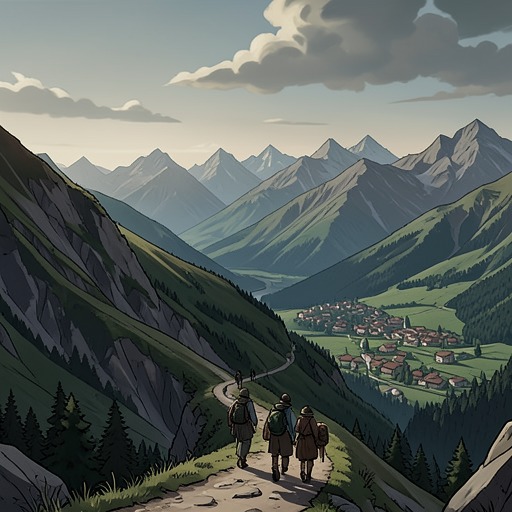
At the end of the 1970s, the parents put on their climbing boots again and went west, toward the Ossola, Valsesia, and Val d’Aosta. The narrator’s mother found the valleys narrow, dark, and enclosed compared with the gentler Veneto and Trentino: the rock was damp and black, and water fell from streams and waterfalls. Higher up, the landscape opened onto Monte Rosa, an Arctic world of permanent winter above summer pastures. It frightened her; to the father it disclosed a greater scale, the mountains of giants beyond the mountains of men. Their annual holidays moved from place to place around the massif, often in a campsite bungalow or hostel room. The father’s attraction to the peaks could outweigh the comfort or familiarity of the temporary homes below them.
Winter, Separation, and Longing
For the father, winter made the contrast particularly sharp. He despised ski resorts and the infrastructure that made downhill skiing possible, objecting to the crowds, the smoothed slopes, and the lifts. In summer, the family might encounter abandoned pylons, disused cable stations, or a rusted wheel stranded among scree. At Christmas, he watched reports of city visitors filling Alpine valleys and kept himself apart, shut inside the Milan apartment. When the narrator’s mother suggested taking him to Grana in the snow, the father refused. He regarded winter as a season when the mountain was not fit for human beings and should be left alone. In his scheme, climbing had to give way to a more serious season of work, flatland life, and black moods.
The narrator eventually acquired the same winter longing that he had once observed in his father without understanding it. In Milan, he reread an Alpine guide as though it were a personal diary, mentally following its routes over grassy ridges, scattered boulders, and residual ice. Meanwhile, the physical evidence of summer faded: scratches and scabs healed, and his legs forgot nettle stings and the cold of crossing streams barefoot. From the apartment, the city could seem like a blurred passage of people and cars, while his days in Grana felt so remote that he wondered whether he had imagined them. A bud growing between traffic lanes brought a change: spring in Milan made the next return to the mountains imaginable. The city’s seasons did not simply oppose the mountain seasons; the first signs of spring there became a promise of going back.
Inherited Routes and Recovered Memory
As an adult, the narrator recognized the contrast in his own life. His father died when the narrator was thirty-one, the same age his father had been at his birth, but the narrator had not married, worked in a factory, or fathered a son. He had left Milan for Turin at twenty-three, following the family idea that a person should leave home at a key point in youth, and built a life there that included precarious work and a hoped-for career in documentary filmmaking. His distance from his father was also emotional: after abandoning university, he and his father had gone a year without speaking. The mountain horizon remained a blessing in the city, but seeing the peaks did not by itself close the distance between them.
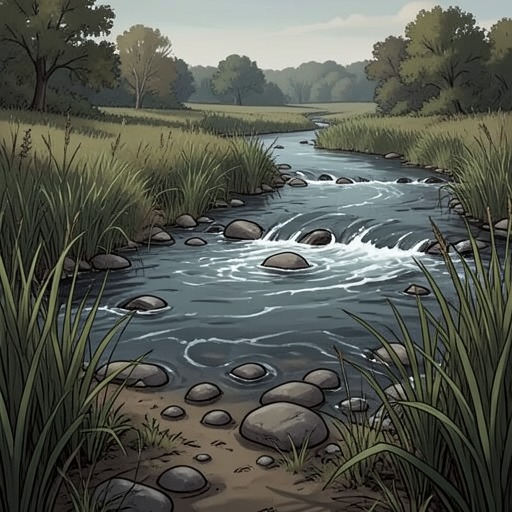
Returning to his inherited property near Grana, he saw how human development had altered the valley: widened roads, protective netting, Tyrolean-style villas, gravel extraction, and a river constrained between cement banks. Closed hotels and idle machinery lent the place the appearance of a building site abandoned after bankruptcy. Snow-covered mountains above the valley consoled him. The gesture of leaning toward the windscreen to look up at them recalled his father’s familiar posture, and he imagined the family life his father might have pictured on such a drive. The inherited gesture made the father present, but as an imagined figure rather than a recovered conversation.
Inside the family home, the narrator found his father’s map still thumbtacked to the wall. It had grown beyond a map of trails into a dense record of two decades, marked in black, red, and green. The narrator worked out that black represented his father, red the narrator, and green Bruno: where the colored lines ended on a glacier while the black line continued, his father had completed the climb alone later. The map thus preserved routes and relationships that had not been explained to the son. Its many black-and-green itineraries also revealed how often his father had gone into the mountains with Bruno, prompting jealousy and relief at once. The mountain record complicated the narrator’s urban image of his father and made the marked terrain resemble a biography addressed, perhaps, to the person who had inherited it.
The father’s mountain life was also preserved in a summit notebook. On a climb, the narrator found his father’s 1997 entry: he had ascended from Grana in three hours and fifty-eight minutes and declared himself still in great shape. The brief note recorded a timed achievement and a moment of good humor, details that the narrator could not retrieve from their strained life in the city. Later, while thinking about glaciers, he understood his father’s image of them as snow from winters long past: a memory that summer had not erased. He came to distinguish the father he had known as a stranger in the city from the mountain-going father who had left him a ruin to rebuild. Building at Barma became a way of remembering that second father.
A Shared Home Between City and Mountain
The contrast acquires a different meaning when the narrator and Bruno build the house at Barma. On a short September day, the narrator’s mother climbed for two hours in the leather boots she had worn since his childhood and was delighted to see what they had made. She looked from the window toward the lake, then went onto the terrace to take in the lake, scree, peaks of Grenon, and the house itself. On the rock wall, the narrator had carved his father’s name and dates, 1942–2004, beside an inscription declaring memory the most beautiful refuge. The house joined practical work to a memorial practice: the father’s name was fixed in the mountain landscape, and the mother’s attentive looking became part of the scene of remembrance.
The narrator then told Bruno, in their mother’s presence, that the house should belong to both of them. He understood the inheritance as something his father had left between them, but also insisted that it should be shared because they had built it together. The decision changes the meaning of the mountain refuge: it is not merely a solitary retreat or a private possession inherited from the past, but a home shaped by collaboration and offered to a friend. The narrator’s mother and the mountain setting witness that declaration, linking family memory to a continuing relationship.
The city-to-mountain movement continues in later journeys and practical work. When the first batch of Bruno’s cheese matured after six weeks, Lara and the narrator took twelve loaves, sixty kilos in all, down toward the valley on a mule. Bruno kissed Lara, patted the mule, and stayed behind to clean the stable; he had decided that transport was not his work and would remain in the mountains until it was time to leave the farmstead for winter. The descent passed the place where the narrator had once watched Bruno ride away on his motorbike, a point in the landscape that held the memory of their long separation. Here movement between mountain and valley serves work and livelihood, not simply escape or return.
Years later, after returning to Italy in 2010, the narrator again found the city and valley marked by crisis and change. He took a coach to the mountains, then followed the path on foot; a mobile-phone mast stood near the tower ruins, and a cement dam interrupted the river where an excavator removed thaw-mud. The route beyond Grana led him to childhood traces, including the old sawmill and a cable wound into the bark of a larch. In another winter, he joined the traffic heading from Milan and Turin toward the ski areas, but no one took the turning for Grana. He continued alone on snowshoes, taking more than four hours to cross a route that took less than two in summer. These returns preserve the contrast while refusing a simple opposition: the city and its traffic remain connected to the mountain by roads and seasons, while the less-visited valley retains its own altered, difficult history. Across the book, the mountain is not merely an alternative to urban life; it is the ground on which the narrator can reread inherited gestures, recover obscured relationships, and make a shared future from what his father left unfinished.